Lately I’ve been finding a lot of information on the railroad that passed through Bollinger county. Originally built by the St. Louis Iron Mountain and Southern, the line eventually fell into the hands of the Missouri Pacific railroad and though few signs remain to remind the public the railroad existed, it was once an engineering marvel, and an important part of the local economy. However, by 1970 times were changing. The December 15, 1970 edition of The Daily Journal (Flat River, Missouri) carried the news of Missouri Pacific’s plan to abandon the line, as well as efforts to save it by local elected officials. According to the paper:
“Congressman Bill D. Burlison spoke out strongly in a letter to the acting chairman of the Interstate Commerce Commission last week, protesting the proposed abandonment of the Missouri Pacific Railroad line from Bismark to Whitewater, commonly known as the Belmont Branch Line.
“It is difficult to predict the full impact abandonment of the line would have on the communities it serves”, Burlison said in his letter to Dale W. Hardin, “We can not estimate the importance of new businesses which may not locate in the area because of the lack of rail facilities,” the congressman noted. “However, we have ample evidence on the impact of existing businesses and the more than 100,000 residents of the four counties.”
The Daily Journal reported that Black River Electric Cooperative received 1300 utility poles by rail in the first nine months of that year at Fredericktown and that the Lutesville Pallet Company had shipped 63 carloads of pallets and received 32 carloads of lumber in the first 10 months of 1970. Also noted by the paper was the news that representatives of businesses and local government had formed an organization and hired a law firm to oppose the abandonment of the Belmont Branch in public hearings.
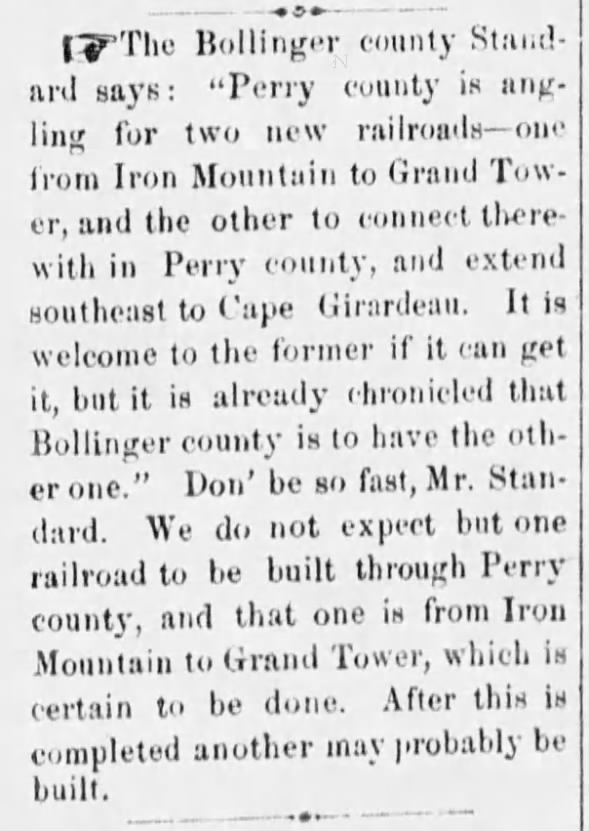
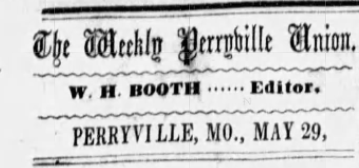
The May 26, 1871 Perryville Weekly Union documented a rivalry of sorts between it and the Bollinger county Standard. The cause of the rivalry was whether or not the Iron Mountain railroad would be built through Bollinger or Perry county. The Weekly Union quoted the Bollinger county Standard which had reported:
“Perry county is angling for two new railroads-one from Iron Mountain to Grand Tower, and another to connect there with in Perry county and extend southeast to Cape Girardeau. It is welcome to the former, if it can get it, but it is already chronicled that Bollinger county is to have the other.”
The Weekly Union warned the Bollinger county Standard not to be so fast, predicting that Perry county would win the route for the Iron Mountain and would probably win over the other railroad as well.
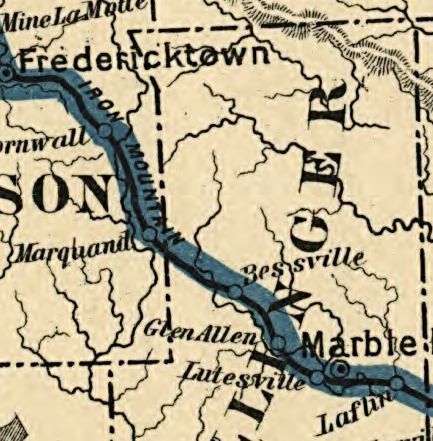
The Belmont Branch of the St. Louis, Iron Mountain and Southern already passed through Bollinger county and was completed in 1869. The railroad started at Bismark, Missouri through St. Francois county before entering Madison county through the communities of Fredericktown and Marquand, next it entered Bollinger county where it passed through Bessville, Glen Allen, Lutesville and Laflin. It continued on a southeasterly route into Cape, Scott and Mississippi counties culminating at Belmont, Missouri at which point it was connected via a ferry across the Mississippi River with Columbus, Kentucky, the Gulf and Ohio railroad and all points east.
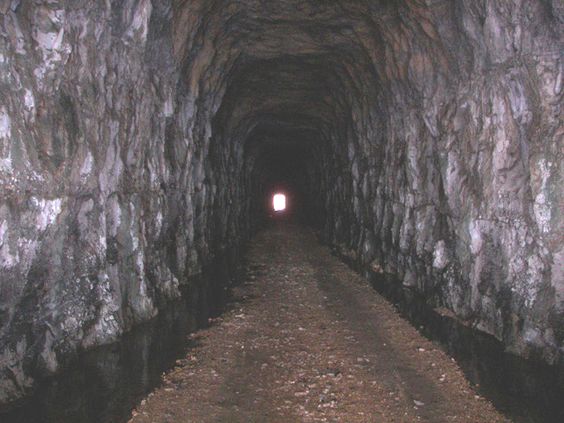
St. Louis, Iron Mountain and Southern railroad tunnel, Glen Allen, Missouri
The proposed route from Iron Mountain never came to fruition but thanks to a helpful reader (who provided a Missouri Pacific Historical Society timeline the mystery has been solved.
“Jackson Branch Railroad Company chartered to build 35 miles of railroad from Attenville, Missouri through Jackson and on into Perry County to a point on the Mississippi opposite Grand Tower in Illinois; first meeting of the Board of Directors held June 16, 1883, with L. H. Davis appointed President; road completed to Jackson by January 6, 1885, and sold on that date to the St. Louis, Iron Mountain and Southern for $ 147,743.87”
If the line had been completed from Jackson to Grand Tower both Bollinger and Perry counties could have claimed the line, along with Cape county as the Jackson Branch connected to the Belmont Branch at Allenville.
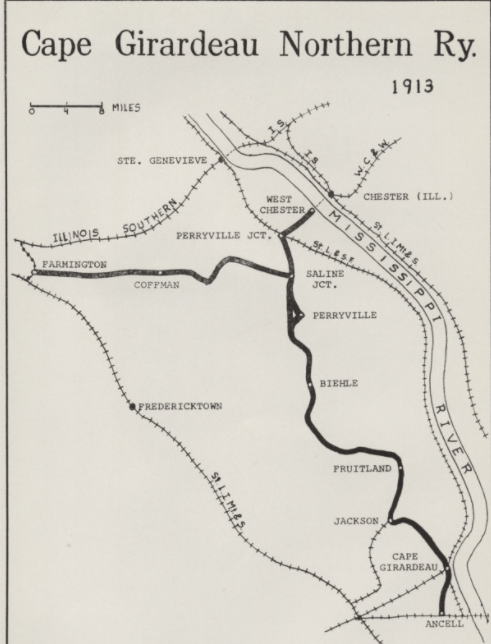
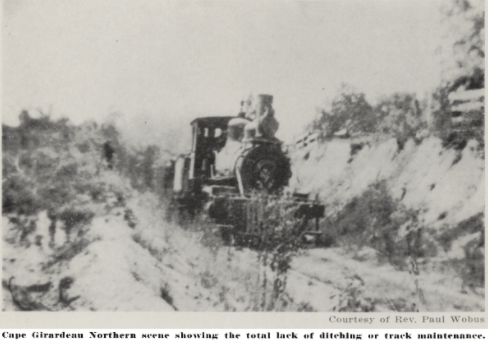
Eventually Perry county did get a railroad that ran from Perryville to Cape Girardeau, the late James Baughn documented the history of the Cape Girardeau and Northern railroad in a blog posted on the Southeast Missourian newspaper website on March 24, 2010:
“Louis Houck, accidental railroad tycoon, wanted to build a railroad connecting Cape Girardeau with towns to the north, an area that had been ignored by other railroads. The first train on his Cape Girardeau & Chester Railroad ran between Cape and Jackson on Nov. 16, 1905. Soon the railroad provided service to Oak Ridge, Perryville, and beyond.
Houck’s railroads had a dubious reputation for low-budget construction and unsafe operations. Investigators for Missouri’s Railroad & Warehouse Department visited the railroad and reported, “We went over the line from Cape Girardeau to Jackson, a distance of 10 miles, and found it to be in a very unsafe condition.”
Baughn continues…
“The railroad, later renamed the Cape Girardeau Northern, reached its peak in 1912 before becoming a money-losing albatross. Houck, who at this point in his career was no spring chicken, was ready to unload his investment in the railroad. By 1913, he believed that he had found a suitable buyer, the Frisco Railroad. However, the deal collapsed when the Frisco went into foreclosure. Houck was stuck with the albatross, much to his dismay.
History may have been much different if the Frisco had successfully taken over the railroad. Located on high ground away from the Mississippi, the tracks between Cape and Perryville would have provided an alternate route during frequent river floods. Fruitland, Pocahontas, Oak Ridge, Daisy, Biehle, Lithium, and other small towns along the route might look very different today if they still had an active railroad.
Out of financial desperation, the Cape Girardeau Northern was forced to discontinue service along portions of the tracks. After Louis Houck died in 1925, a new owner was finally found for the railroad: the Missouri Pacific. However, they only took control of portions of the line near Cape Girardeau.”
Foothills Media Baseball Cap
Support independent media by purchasing a Foothills Media LLC baseball cap. Stylish and comfortable, 100% cotton, adjustable , one size fits all. This hat features our trademark Foothills Media logo on the front and our web address (www.foothillsmedia.com) on the back.
The Perryville Weekly Union archives have really turned out to be a treasure trove for Southeast Missouri history. The May 15, 1863 edition of the paper reports of Frank Valle capturing capturing local militia members stating:
“Militia Captured – We are informed that on last Sunday evening, while Henry Farrar, Daniel Rhyne and Major Clifton, members of a company of the Enrolled Militia of this county were on their road to Iron Mountain, were captured by Frank Valle and his followers in St. Genevieve county. They were compelled to take the Confederate oath. Their horses were taken or stolen from them when they were set at liberty.”
The Perryville Weekly Union predicted that Southern sympathies would be short lived but (as I wrote in a previous blog post) a year later the Perryville Weekly Union reported that Frank Valle had been nominated as a delegate to the State Convention of 1864. The paper in its July 8, 1864 issue reported:
““We received a letter a few days since from some of our friends in Bollinger county, inquiring of us if Frank Valle was nominated by the Democracy of this county as a delegate to attend the Convention held in St. Louis by the Democracy last month. We say to our friends in Bollinger that Mr. Valle was nominated by some persons of Perry county at that meeting, but we are informed that he did not attend said convention, owing to not having received the news of his nomination.”
A year after its original prediction that Southern sympathies would be short lived, the paper was once again renewing its prediction, though less boastfully:
“Until recently this county has been peaceable and quiet, although a disloyal sentiment to a considerable extent has prevailed, ever since the commencement of the rebellion, and it is hoped, (the disloyalty of the citizens to the contrary notwithstanding ) that order and peace would not be disturbed. Many who saw, or thought they saw, into the future, predicted that peace would be of short duration. They argued thus wise , although many of the leading secessionists have much to lose, and fear to lose it, they will so manage to get all the evil disposed men of the community fully enlisted in the rebellion, that, by harboring Frank Valle and his gang, who have been frequently seen at houses of wealthy secesh by giving aid, comfort, information, and assistance to the enemies of the country, and fully assuring them of their co-operation and assistance.”
Foothills Media Baseball Cap
Support independent media by purchasing a Foothills Media baseball cap. 100% cotton, fully adjustable, one size fits all. This cap features our trademark Foothills Media logo on the front and our web address (www.foothillsmedia.net) on the back.
Most of us were probably taught that the American Civil War was fought over slavery. In reality, the reasons for the war were far more complicated. Abraham Lincoln issued the emancipation proclamation on January 1, 1863. This was done for political purposes.
“In August 1862, Lincoln stated: “If I could save the union without freeing any slaves I would do it; and if I could save it by freeing all the slaves I would do it; and if I could save it by freeing some and leaving others alone I would also do that.”
“President Abraham Lincoln issued the Emancipation Proclamation on January 1, 1863, as the nation approached its third year of bloody civil war. The proclamation declared “that all persons held as slaves” within the rebellious states “are, and henceforward shall be free.”
In short, Lincoln’s proclamation only freed slaves in areas that the Union did not control.
In 1863 Perry County, Missouri was by and large controlled by Union authorities. Therefore, it is not surprising that the May 15, 1863 edition of the Perryville Weekly Union reported the following:
“NEGROES ARRESTED- Two negro boys were arrested last Monday morning, by Assistant Adjutant General Huff, of General McCormick’s staff, near Perryville and lodged in the Perry county jail. They told several conflicting tales, but from the best information obtained, it appears that the belong to a man by the name of Seabaugh, of Bollinger county, and were going to Illinois. Another was arrested on the same day by James Burgee and Augustus Doerr between this place and Chester, and brought here and placed in jail.”
Foothills Media LLC has a limited supply of signed copies of Blood in the Ozarks: Expanded Edition. Paperback, 306 pages. Official records, newspaper articles, interviews with former slaves and personal stories were all used to document Civil War atrocities in Missouri , with an emphasis on Southeast Missouri.
From the June 19, 1867 Daily Missouri Republican, a story of a horse thief from Bollinger county horse thief named “Brake” and a Madison county sheriff who planned to “break” him of his hobby.
The writer of the article had fun with a little play on words. Quoting from the article:
“Sheriff Cooper, of Madison county, on the 12th inst., Alson J. Brake, of Bollinger county, and had him locked up in Fredericktown jail. Brake had “borrowed”a horse, saddle and bridle from a citizen of Madison county and roped him off into Bollinger, where his father resides. The intention is to break Brake of his fondness for the flesh of other people’s horses. If he don’t break jail, this may be done , though the horse was a bay and not dun.”
Support independent media by shopping at our bookstore.
I’ve been finding some historical gems in the archives of the Perryville Weekly Union as of late. Some are rare historical finds while some are are historical and humorous. This is of the humorous variety.
The May 29, 1863 edition of the paper carried the story of a Mr. Herwig who was arrested by Sheriff McBride un suspicion of stealing a mule. Herwig aroused the suspicion of the sheriff because he was riding the mule bareback.
The Perryville Weekly Union reported:
“A man by the name of Dr. Herwig was arrested by Sheriff McBride last Monday morning, some ten miles from Perryville on the road leading to Chester and brought here.- At the time he was arrested he was riding a mule bareback, which was believed to be stolen property. On Tuesday evening Herwig asked the sheriff to allow him to go to Cook’s and get some beer, which was granted, when he went off and hid himself in a large hogshead [barrell] in the cellar of Mr. Cook’s.”
Herwig was soon found and “lodged in the jail” until the matter could be resolved, which it eventually was when Mr. Masterson, the rightful owner of the mule arrived in Perryville. The paper ended the article by declaring, “the prisoner we guess will not go unpunished.”
Support independent media by visiting our bookstore.
The Friday May 29, 1863 edition of the Perryville Weekly Union reports that guerrillas (Southern partisan fighters) intercepted a Union captain and some other Union troops from Madison County, Missouri were traveling to Patton, Bollinger County Missouri to get some men of the Enrolled Missouri Militia resulting in a small skirmish. Note that the newspaper misspelled Patton as “Paton”.
“It seems a Captain and some few others , residing in Mine la Motte, Madison county, on Wednesday of last week, started to Paton, in Bollinger county, for the purpose of getting a few men belonging to the Enrolled Missouri Militia. While out on this business they were attacked by guerrillas from seven miles from Paton, and one man was killed and two taken prisoners by the guerrillas, the others made their escape and reached Fredericktown the next day in safety. We also learn that they lost two or three horses.”
Blood in the Ozarks: Expanded Second Edition
We have a limited supply of signed copies of this book which documents Union atrocities against Southern sympathizers and civilians in Missouri. The book is over 300 pages. Official records, newspaper archives , personal stories and the testimony of former slaves were all used to document the time in our history.
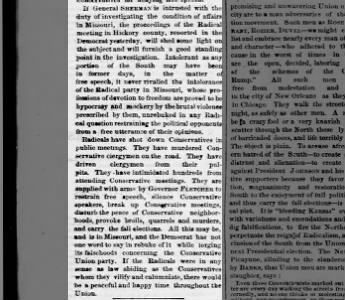
“The radicals of the era , as they referred to themselves, imposed harsh treatment of Southern sympathizers both during and after the war. In fact, after the war, they turned on the Germans.”
Proof of this can be found in the August 11, 1866 edition of the Daily Missouri Republican newspaper which published the following account of Radical Republican rule in Missouri:
“Intolerant as any portion of the South may have been in former days, in the matter of free speech it never rivalled the intolerance of the Radical party in Missouri, whose professions of devotion to freedom are proved to be hypocrisy and mockery by the brutal violence prescribed by them, unrebuked in any Radical question restraining the political opponents from a free utterance of their opinions.”
Radicals have shot down Conservatives in public meetings. They have murdered Conservative clergymen on the road.
August 11, 1862 Daily Missouri Republican
The paper continued:
“Radicals have shot down Conservatives in public meetings. They have murdered Conservative clergymen on the road. They have driven clergymen from their pulpits. They have intimidated hundreds from attending Conservative meetings. They are supplied with arms provided by Governor Fletcher to restrain free speech, silence Conservative speakers, break up Conservative meetings, disturb the peace of Conservative neighborhoods, provoke broils, quarrels and murders and carry the fall elections.”
Blood in the Ozarks: Expanded Second Edition
Blood in the Ozarks: Expanded Second Edition uses official records, newspaper accounts, personal stories and interviews of former slaves to tell the story of Union atrocities against Southern sympathizers and civilians in Missouri during the War Between the States. We have a limited quantity of signed copies available. Price includes shipping and tax.
The July 8, 1864 issue of the Perryville Weekly News (Perry county, Missouri) paid special attention to inquiries from Bollinger County, to its paper seeking information pertaining to whether or not a Perry county resident by the name of Frank Valle had been nominated to the state convention. According to the paper:
“We received a letter a few days since from some of our friends in Bollinger county, inquiring of us if Frank Valle was nominated by the Democracy of this county as a delegate to attend the Convention held in St. Louis by the Democracy last month. We say to our friends in Bollinger that Mr. Valle was nominated by some persons of Perry county at that meeting, but we are informed that he did not attend said convention, owing to not having received the news of his nomination.”
In a related article published in the same issue of the Perryville Weekly News, the paper reported:
“Until recently this county has been peaceable and quiet, although a disloyal sentiment to a considerable extent has prevailed, ever since the commencement of the rebellion, and it is hoped, (the disloyalty of the citizens to the contrary notwithstanding ) that order and peace would not be disturbed. Many who saw, or thought they saw, into the future, predicted that peace would be of short duration. They argued thus wise , although many of the leading secessionists have much to lose, and fear to lose it, they will so manage to get all the evil disposed men of the community fully enlisted in the rebellion, that, by harboring Frank Valle and his gang, who have been frequently seen at houses of wealthy secesh by giving aid, comfort, information, and assistance to the enemies of the country, and fully assuring them of their co-operation and assistance. They would soon set up a Union howl, croak loyalty, and impose on the ignorant and unwary, foist themselves onto the councils of the loyal; and by false representations, thrust themselves into important decisions, both civil and military, proclaim that the radicals are the enemy of the country and invite their confederates to the country and rob and murder at pleasure. As a part of the programme, the militia of this county, especially the “Dutch” were to be disarmed, the enrolled militia, as much as possible to be under the control of con’s, (you can make that word confederates if you like, just as well to mean conservatives)”
There are a few key items to point out in this article. The first is that German immigrants were often referred to as “Dutch” and were loyal to Abraham Lincoln and the Union. The radicals of the era , as they referred to themselves, imposed harsh treatment of Southern sympathizers both during and after the war. In fact, after the war, they turned on the Germans.
Other notable subjects of this article were Peter (Pete) Fisher, a Bollinger county resident who led an irregular Confederate cavalry unit during the war.
Blood in the Ozarks: Expanded Second Edition
Foothills Media has a limited quantity of signed copies of “Blood in the Ozarks: Expanded Second Edition”. The book contains over 300 pages of information documenting Civil War atrocities in Missouri with a special emphasis on Southeast Missouri. Official records, newspaper accounts, the testimony of former slaves and personal stories were utilized to document this story.






 Foothills Media LLC