In Post-War Bollinger County, Republicans Weren’t Welcome

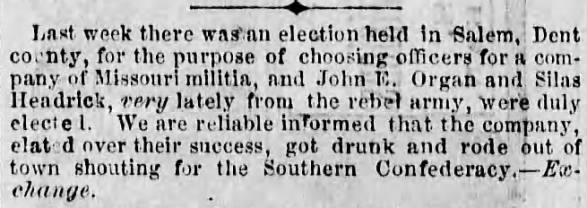
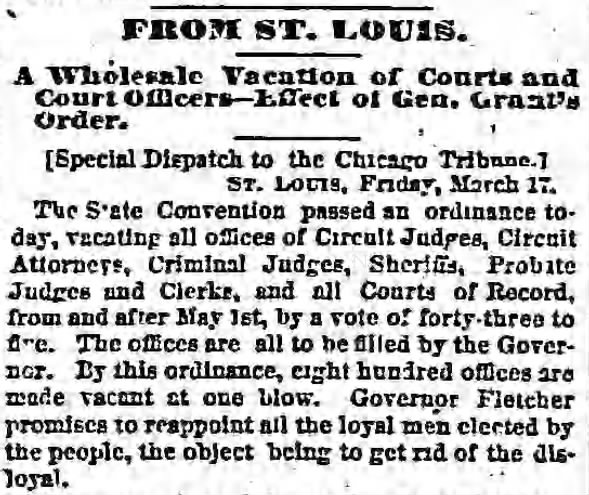
One account of Bollinger County, Missouri during the Civil War called it a “hotbed of secession”, Historian Glen Bishop, (whose speech at the Bollinger County Museum of Natural History was covered in the September 4, 2011 Southeast Missourian Newspaper) stated that 6 out of 10 men in Bollinger County sided with the South during the war.

Not surprisingly, many of these men either fled the state or lost their property during the war. A common practice was to claim back taxes owned on the land that were not paid during the hostilities. When the land owners couldn’t pay, they county took the land. In other instances during the war men who were charged with being Southern sympathizers would have to take an “Oath of Allegiance” and put up a bond. If the accused did not have the cash for the bond, they were allowed to use their property. In the event they were accused of disloyalty again, the property was forfeited and often time the accused sent to prison.

It is important to remember that during and after the War most Southerners were Democrats and most Unionists were Republican, of course most Southerners could not hold office or vote until the Drake Constitution (which served as the basis for Missouri Reconstruction) was abolished in 1875.

By 1872 land in Bollinger County could be found advertised in papers throughout the United States but as some would find out, the land was not much of a bargain. Evidence of this can be found in the August 5, 1872 Inter Ocean newspaper (Chicago, Illinois) and the August 8, 1872 Boston Globe (both articles being republished from the St. Louis Globe).

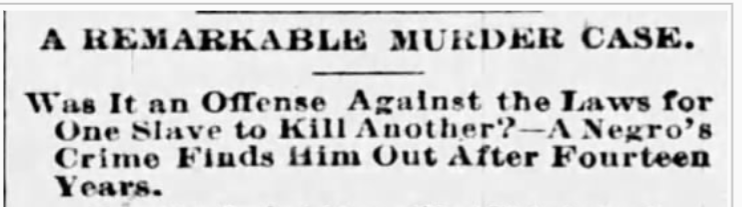
Republicans intimidated in Bollinger CountyRepublicans intimidated in Bollinger County Mon, Aug 5, 1872 – Page 6 · The Inter Ocean (Chicago, Illinois) · Newspapers.com KKK Intimidation, Bollinger County, MissouriKKK Intimidation, Bollinger County, Missouri Thu, Aug 8, 1872 – 4 · The Boston Globe (Boston, Massachusetts) · Newspapers.com

Processing…
Success! You're on the list.

Union Veterans Blamed for Robberies in Bollinger County

Lancaster, Pennsylvania’s Journal Intelligencer newspaper carried news of a string of robberies being committed in Bollinger County, Missouri in its May 29, 1868 issue.

The paper stated that the perpetrators wore masks and Union overcoats and stated it was probably some of “Logan’s GAR’s”.

Union War Veterans Blamed for Robberies in Bollinger County, MissouriUnion War Veterans Blamed for Robberies in Bollinger County, Missouri Fri, May 29, 1868 – 2 · Intelligencer Journal (Lancaster, Pennsylvania) · Newspapers.com

I knew who “Logan” was. The paper was referencing Union General John A. Logan (from Southern Illinois), he founded the Grand Army of the Republic in 1868, which was a fraternal organization for Union veterans of the Civil War.

At first I thought the “Logan” reference was to a local GAR chapter in Bollinger County but I can find no record, there were to GAR chapters in Bollinger County, Missouri, the Shanks chapter in Lutesville / Marble Hill and the Pape chapter in Zalma.

The paper in its statement that the robbers were probably some of “Logan’s GAR’s was a reference to the organization in general. Army History {.org} states that:

“Following the Civil War, Logan was instrumental in the founding of the Grand Army of the Republic (GAR), a veterans group comprised of former Union Army soldiers, and served as the GAR’s second elected national commander; General Stephen Hurlburt was the first commander in chief of the GAR.  On 3 March 1868, Logan issued General Order No. 11, which called for a national day of remembrance for Civil War dead.  This order served as the basis for what became the national holiday of Memorial Day.”

General John A. Logan, a veteran of the Union army and founder of the G.A.R.

Sons of (Union) Veterans Arrested in Marble Hill.

http://www.foothillsmedia.net

The date was May 30, 1889 and both Union and Confederate veterans gathered in Marble Hill, Missouri to join in a memorial to those who had died in the Civil War. The July 11, 1889 edition of the Erie Sentinel reported that Sons of (Union) Veterans Camp #50 fired the salute (with blank cartridges). Afterwards the Union and Confederate veterans went to the Bollinger County courthouse to continue the service. It was at this time that the members who fired the salute, brought their rifles in the courthouse and were arrested because of it. While the paper states it was Sons of Veterans Camp #50, an Sons of Union Veterans newsletter lists the men as being members of Thomas Fletcher Camp #56.

Sons of Confederate Veterans members arrested for firing a salute for Memorial Service.Sons of Confederate Veterans members arrested for firing a salute for Memorial Service. Thu, Jul 11, 1889 – 1 · Erie Sentinel (Erie, Kansas) · Newspapers.com

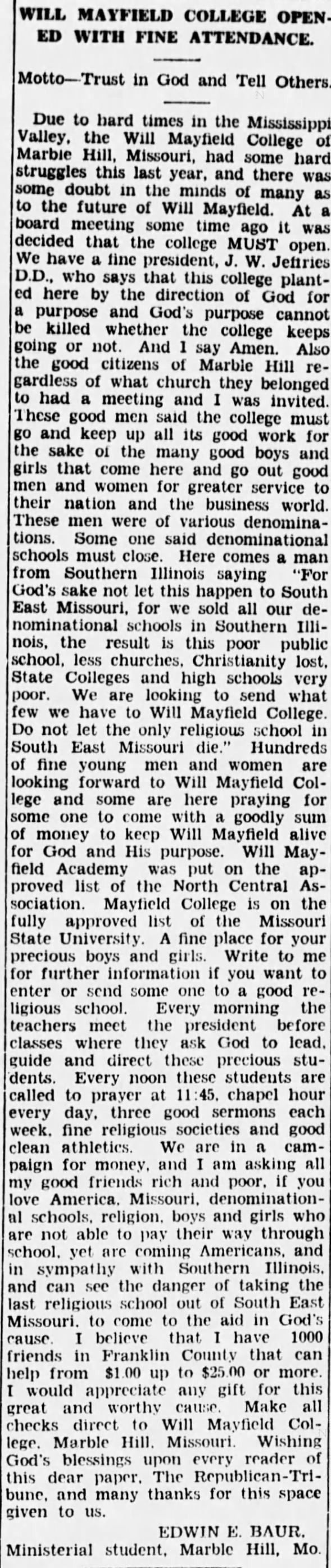
St. Louis Globe Democrat Paid Tribute to Will Mayfield & Bollinger County, Missouri

The August 23, 1925 issue of the St. Louis Globe-Democrat covered the counties of Southeast Missouri in its “Travelog” series of the state. Included in the article is a substantial article about Bollinger County and William Mayfield, who the Globe described as “the County’s leading citizen” and “after many hearbreaking experiences and tribulations finally succeeded in founding the Will Mayfield College there.”

The Globe, in its coverage of the counted also painted a picture of what it was like to live in the county during the Civil War.

http://www.foothillsmedia.net
Bollinger County, Will MayfieldBollinger County, Will Mayfield Sun, Aug 23, 1925 – 19 · St. Louis Globe-Democrat (St. Louis, Missouri) · Newspapers.com

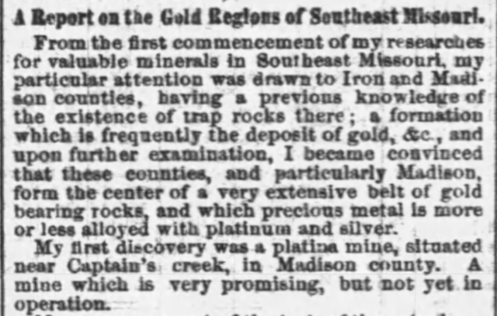
Will Mayfield Part. 2Will Mayfield Part. 2 Sun, Aug 23, 1925 – 19 · St. Louis Globe-Democrat (St. Louis, Missouri) · Newspapers.com Mayfield Part. 3Mayfield Part. 3 Sun, Aug 23, 1925 – 19 · St. Louis Globe-Democrat (St. Louis, Missouri) · Newspapers.com

Processing…
Success! You're on the list.

The Dedication of Sam A. Baker State Park

Photo courtesy of Missouri State Parks

The July 5, 1928 edition of the Wayne County Journal-Banner carried the story of the [then] upcoming dedication of the Sam A. Baker State Park, even Missouri Governor Sam A. Baker was slated to speak at the event.

The park is an old favorite destination to many of us in the Eastern Ozarks and the story contains accounts of early settlers of Wayne County, the Civil War (including General Sterling Price’s 1864 raid) and the location of “Rocky Battery”, which I have been wondering about since reading Paulette Jiles’ 2003 book “Enemy Women.”

Dedication of Sam A. Baker State ParkDedication of Sam A. Baker State Park Thu, Jul 5, 1928 – 1 · Wayne County Journal-Banner (Piedmont, Missouri) · Newspapers.com

Deadly Storm Cost Lives, Injuries

The June 1, 1917 edition of the Natchez Democrat (Natchez, Mississippi) reported on the deadly storms that passed through Southeast Missouri and Southern Illinois. The paper reported that the storm did the most damage in Wayne and Bollinger Counties, with the heaviest loss in Zalma where 25 lives were lost and 200 injured.

Deadly Storm at Zalma, Missouri. June 1,1917Deadly Storm at Zalma, Missouri. June 1,1917 Fri, Jun 1, 1917 – Page 1 · Natchez Democrat (Natchez, Mississippi) · Newspapers.com
  • Clint Lacy is an author and publisher and founded Foothills Media LLC in February, 2019. His latest release is “The Rape of Delaware County.” Oklahoma used to be a safe haven for outlaws, in Delaware County it still is. The only difference is that some of them wear badges and others have law degrees. $10 paperback, 145 pages.

New Release: The Rape of Delaware County

April 14, 2014 was a typical peaceful evening at the Turlington family farm outside of Jay, Oklahoma when Edwin Turlington saw what looked to be a fire burning on the portion of the property nearest to the highway. Upon investigating Edwin found what appeared to be three trespassers attempting to manufacture meth Upon confronting them one picked up a glass bottle and charged. In self-defense Edwin shot him one time in the leg. The story takes a unique twist when the criminal is allowed to walk free and Edwin is charged for the shooting. Facing a possible ten year jail sentence, Edwin Turlington launched his own investigation which revealed that, in Delaware County, Oklahoma the criminal justice system was corrupt from top to bottom. The use and protection of informants, millions of dollars in lawsuit settlements for rape and abuse in the county jail and a defense attorney who made international headlines in a murder for higher plot. Delaware County , Oklahoma was once a safe haven for outlaws and as Edwin Turlington soon found out, it still is. The only difference is that in the 21’st Century some outlaws wear badges and others have law degrees hanging on their wall. Paperback, 145 pages.

Missouri Governor Claiborne Fox: Secessionist or Peacemaker?

Most mainstream history accounts of Missouri Governor Claiborne Fox Jackson describe him as having a secessionist agenda. Lately I’ve been digging through newspaper archives of the era and what I’ve found is that they paint a different picture of Governor Jackson than contemporary accounts describe.

First Governor Jackson was elected in 1860 as a Douglas Democrat. Using Wikipedia (for reasons of convenience) the Douglas wing of the Democratic Party:

“The Northern Democratic Party was a leg of the Democratic Party during the 1860 presidential election. It was when the party split in two due to problems with slavery. Stephen A. Douglas was the nominee and lost to Abraham Lincoln. They held two conventions before the election, in Charleston and Baltimore, where they established their platform…

  • They resolved that the party will obey the decisions of the supreme court on the questions of constitutional law.
  • That the United States has a duty to provide protection to all citizens, at home and abroad, whether they are native or foreign.
  • That the Democratic party will insure the construction of a railroad to the Pacific coast as soon as possible, to facilitate fast communication between Atlantic and Pacific states,
  • That they support the acquisition of Cuba, as long as the terms are agreeably to the United States and Spain.
  • That the attempts to defeat the execution of the Fugitive Slave Law, are hostile, undermine the Constitution, and revolutionary in their effect.
  • That while Territorial Governments are in existence, the measure of restriction imposed by the Federal Constitution on the power of the Territorial Legislature over the subject of the domestic relations shall be respected and enforced by every branch of the General Government.”

In short the reasons Governor Jackson aligned himself with the Douglas Democrat’s is because it satisfied the Unionists the slave holders.

Missouri’s Governor Claiborne Fox Jackson had consistently stated that he would pursue peace if the Federal Government did not make war upon the South but as stated previously, Lincoln had held his cards close to his vest on the Fort Sumter matter, feigning peace, while secretly contacting the fort’s commander Major Anderson planning to resupply the fort by force and when a dispatch was intercepted by General P.G T. Beauregard’s men in Charleston, revealing the plan, the general was forced to act. 

Even as tensions were rising, Missouri’s government was dedicated to peace and the best way to ensure the peace was “Armed Neutrality”. 

Armed Neutrality was meant to keep Missouri from being taken over by the Federal Government and forcing the State to supply troops to wage war on its sister Southern states. In addition, “beefing up” Missouri’s defensive posture would also act as a deterrent to any plans the Federal Government might have to subjugate the state. 

On May 3, 1861 the Daily Milwaukee News published the following news from Missouri: 

“The Sentiment in Missouri: 

The announcement on the street and in business circles yesterday, that Governor Jackson had emphatically declared his opposition to the secession of Missouri, and avowed himself in favor of this state occupying a position of neutrality and created a general feeling of relief in all quarters except among those who think the course Missouri is the mad one of withdrawal of the Confederacy. 

Governor Jackson has been regarded as an open and avowed secessionist (though to do him justice, we have never seen a positive declaration of secessionist views of him.)” 

The May 6, 1861 edition of the Baltimore Sun carried the details of Governor Jackson’s address to the Missouri Legislature. Again, Jackson’s message was peace and self-defense to protect from invasion: 

“St. Louis, May 3- The Legislature of Missouri was organized today. Governor Jackson, in his message says: 

“The President in calling out troops to subdue the seceded states, has threatened civil war, and his act is unconstitutional, and illegal, and tending towards a consolidated despotism.” 

While the Governor justifies the action of the Confederate States in seceding, he does not recommend immediate secession, but uses the following language: 

“Our interests and sympathies are identical with the those of the other slaveholding States, and necessarily unite our destiny with theirs, the similarity of our social and political institutions, our industrial interests, our sympathies, habits and tastes, our common origin, and our territorial contiguity, all concur in pointing to our duty in regard to the separation now taking place between the states of the old federal Union.”, He adds: 

“Missouri has, at this time, no war to prosecute. It is not her policy to make aggressions on any state or people. But in the present state of the country, she would be faithless to her honor and recreant to her duty were she hesitate a moment in making the most ample preparations for the protection of her people against the aggressions of all assailants. I therefore recommend the appropriation of a sufficient sum of money to place the State at the earliest practicable moment, in a complete state of defense.” 

In conclusion he says: Permit me to appeal to you and through you to the whole people of the State, to whom we are responsible, to do nothing imprudently or precipitately. We have a most solemn duty to perform; let us calmly reason one with the other; avoid all passion, all tendency to tumult, and disorder, and obey implicitly the constituted authorities, and endeavor ultimately, to unite all of our citizens in a cordial cooperation for the preservation of our honor, the security of our property, and the performance of all those high duties imposed upon us by our obligation to our Family, our country, and our God.” 

Even Vermont’s St. Albans Daily Messenger, in its May 8, 1861 issue, praised Governor Jackson for his efforts to keep the peace writing: 

“The Governor is doing all in his power to stay the secession tide. He tells the people, and tells the truly, that it is for the interest and welfare of the people of Missouri to stand by the Stars and Stripes and that it would be the height of folly and madness for her to follow in the footsteps of the seceded states.” 

One could say that Governor Jackson was eventually forced into action and eventually secession.

The state militia had been ordered to encamp in St. Louis for drill. Some accusations from contemporary historians state the purpose was to take the arsenal at St. Louis, this however, is a flawed theory.

On April 29, 1861 The Daily Exchange [Baltimore, Md.] published:

“April 26- A Chicago dispatch, published in the Evening Post, says that last night a strong force of Illinois troops entered St. Louis and took from the arsenal 21,000 stand of arms, and a park of artillery, and an immense quantity of ammunition etc. There was no fighting.” 

There was no reason to take the arsenal because Illinois troops had invaded the state and took the weapons back to their state.

On May 10, 1861 Captain [later General] Nathaniel Lyon ordered the camp surrounded at which time the camp was surrendered. Lyon’s soldiers were made up of mostly Germans and when these men were seen marching the native Missourians through St. Louis at gunpoint, the citizens became enraged and the German’s fired upon them. The event lasted two days and resulted in the deaths of 28 civilians, including one infant.

St. Louis Unionist, Francis P. Blair’s brother Montgomery Blair was the United States Postmaster General and it was through this connection that Blair and Lyon conspired to have the level headed General William S. Harney removed from his position of heading up the U. S. Army’s Department of the West. Blair and Lyon then used this same connection to give Harney’s position to the erratic, hot- head, Nathaniel Lyon.

Following the removal of Harney, Lyon was made a general, which worried Governor Jackson and former Governor Sterling Price.

Information found at The Civil War Muse states:

“The removal of Harney was disturbing to Governor Claiborne Jackson and Major-General Sterling Price. The Missouri State Guard was still poorly organized and equipped. The Federals had over 10,000 armed troops. They realized they needed more time. Moderates in Jefferson City thought Lyon was radical and rash and they were still interesting in preserving the peace. They convinced the Governor that he needed to meet with Lyon and Blair. Similarly, moderates in St. Louis convinced Lyon and Blair that a meeting was necessary. Brigadier General Nathaniel Lyon issued a safe conduct pass to Jackson and Price for their visit to St. Louis. 

On June 10th, Governor Jackson and Major-General Price boarded a private train and traveled to St. Louis, registering at the Planter’s House Hotel. On June 11th Brigadier-General Nathaniel Lyon, Colonel Frank Blair and an aide Major Horace Conant left the Saint Louis Arsenal and arrived at the Planter’s House around 11 a.m. They met with Jackson, Price and the Governor’s aide, Thomas L. Snead. 

When the meeting began, Lyon said he was going to let Colonel Blair conduct the meeting. During the ensuing discussion Price emphasized that the Price-Harney Agreement was still in effect and that Price planned to keep to his side of the agreement. Lyon was quiet for the first 30 minutes or so, but then proceeded to take over the meeting. It became clear that the degree of distrust on each side was too much to overcome. After four or five hours, Lyon said upon rising to leave: 

Rather than concede to the State of Missouri the right to demand that my government shall not enlist troops within her limits, or bring troops into the State whenever it pleases, or move troops at its own will into, out of, or through the State; rather than concede to the State of Missouri for one single instant the right to dictate to my government in any matter, however unimportant, I would see you, and you, and you, and you, [pointing to each man in the room] and every man, woman, and child in the State dead and buried. This means war. In an hour one of my officers will call for you and conduct you out of my lines.

Jackson, Price and Snead did not wait for Lyon’s officers, but hurried to the Pacific Railroad depot and commandeered a train to take them to Jefferson City. They arrived there around 2:00 A.M. on June 12th. Along the way Jackson and Snead worked on a proclamation to be issued when they arrived in Jefferson City. Price also sent orders to burn the railroad bridges over the Gasconade and Osage Rivers behind them. Price also ensured the telegraph wires were cut. On June 12th, Snead issued the proclamation while Jackson directed the evacuation of the state government from Jefferson City. In conjunction with the Governor’s proclamation, Major General Sterling Price issued orders to each military district commander of the Missouri State Guard to assemble their forces and have them ready for service. Price had convinced Jackson that Jefferson City was lost and their first line of defense should be in Boonville, Missouri, about 50 miles upriver. “

On June 11th Brigadier-General Nathaniel Lyon, Colonel Frank Blair and an aide Major Horace Conant left the Saint Louis Arsenal and arrived at the Planter’s House around 11 a.m. They met with Jackson, Price and the Governor’s aide, Thomas L. Snead.

On June 12, 1861 Governor Jackson issued the following proclamation:

A series of unprovoked and unparalleled outrages have been inflicted upon the peace and dignity of this Commonwealth and upon the rights and liberties of its people by wicked and unprincipled men, professing to act under the authority of the United States Government . . . I, Claiborne F. Jackson, Governor of the State of Missouri, do . . . issue this my proclamation, calling the militia of the State to the number of fifty thousand into the active service of the State, for the purpose of repelling [the Federal] invasion, and for the protection of the lives, liberties, and property of the citizens of this State.

With Federal forces closing in on Jefferson City, the capital was evacuated with the legislatures taking the State seal with them and the Unionists soon claimed the legislature was vacated, held a convention , enacted a provisional government and made Hamilton Gamble the “new” Governor.

Following the battles at Boonville, Oak Hill [Wilson’s Creek] and Lexington, Missouri, the elected State Government who were forced to abandon Jefferson City (at gunpoint), reconvened at Neosho, in Missouri’s southwest corner, and passed an ordinance of secession on August 31,’st, 1861. Missouri was then accepted into the Confederacy (by the Confederate Congress) on November 28, 1861.

Governor Claiborne Fox Jackson died in 1862 and was succeeded by Lt. Governor Thomas Reynolds. The Missouri government eventually set up shop in Marshall, Tx., which, for the rest of the war was the Capital of Missouri.

Governor Claiborne Fox Jackson became a secessionist, only when he had no other choice and should be remembered as a Governor who tried to keep Missouri out of the war.

The Bollinger County Light Horse Cavalry

Flag of the Bollinger County [Missouri] Light Horse Cavalry

Cletis Ellinghouse, wrote in his book “Old Wayne”:

“Southeast Missouri’s renowned and railroader, Louis Houck, in his memoirs noted Judge Jackson at the outbreak of the war raised the U.S. flag at the courthouse at Greenville, in defiance of popular sentiment, which strongly favored the Confederacy. It created what Houck called, “a local war.”

It may be significant to note that the Bollinger County Light Horse Cavalry was the first Confederate unit organized in this neighborhood, in mid-March of 1861, which was nearly a month before the South attacked Fort Sumter in South Carolina on April 12, 1861. It attracted a good number from Wayne [County] including Rufus and Christopher Holmes, respectively a sergeant and second lieutenant, sons of long-time Justice of the Peace John B. Holmes, as well as their cousins in Bollinger County, Joseph and Henry Bennett, privates, sons of Alexander Bennett and his first wife the former Debby Dennis , believed the eldest daughter of early settler John Dennis Sr.”

Glenn Dedmondt in his book “Flags of Civil War Missouri” writes:

“One unusual flag captured by the Freemont Rangers in the fall of 1861, the ensign of a company of the 1’st Cavalry Battalion of General M. Jeff Thompson’s 1’st Division, was made of black silk with a red cross on it.”

Impending War

Original Artwork by Curtis Copeland

Something a little different from me today. A fiction piece titled “Impending War” for an event that paired writers and artists for State of the Ozarks magazine in 2018. I was paired with artist Curtis Copeland, some of you may remember that Curtis and I worked together on a story about the existence of Black Panthers in Missouri.

Cotton was not king in the Ozarks but hard work was. The soil was not suited for farming. If it had been the planters would have bought it up and brought their slaves with them.

Planting was done in small clearings. It was no easy task and the crops grown in the rocky soil were done so for subsistence, not cash.

Some of the corn was used to feed the cattle and some was ground into meal for the family.

News was slow to travel to the Ozarks but when it did arrive it brought word of the impending war.

My father doubted the war would make it to our isolated homestead.

Leaning against a split rail fence he stated, “There is barely enough for us to survive on, much less enough to fight over.”

He was in deep thought. He shifted the rocky soil back and forth with his foot and it was not clear whether he was trying to convince me or himself. With pipe in hand , he pointed at the barn and said, “Harness the mule son. We’ve got a crop to put in”.

From time to time a neighbor would bring news on the current state of affairs. Jim Sutton stopped by one day and stated the Governor had met with Captain Lyon in St. Louis to negotiate a peace and that the meeting had ended with Captain Lyon declaring war on the Governor, the State and every man, woman and child who lived there.

News traveled “through the grapevine” in the mountains, from neighbor to neighbor. Newspapers were a rarity. Partly because of  isolation and partly because more than a few settlers could not read and had very little time for such luxuries even if they could. Despite the rumors of war, there was always work to be done. Wood needed to be chopped, livestock fed and fences repaired.

Most of our neighbors were of Scots-Irish who had immigrated from the neighboring states of Kentucky and Tennessee. They were Southerners of a different social class. A working class who placed more emphasis on necessary labor and taking care of their families and neighbors than the politics of the day.

August brought news of a great battle in the Western portion of the state and another visit from Jim Sutton.

I had just finished my chores for the day and had drew a bucket of water from the well. I dipped the ladle into the bucket and was taking a sip of the cool water when I saw Mr. Sutton ride up on his horse.

“Howdy Elijah”, he said with a smile, “Is John around?”

“Daddy’s in the barn Mr. Sutton” , I said. 

My father walked out of the barn and said, “Howdy Jim. What brings you around?”

Jim Sutton climbed off of his horse and shook Daddy’s hand. “Can I talk to ya?”

They went to the barn but I could still make out part of the conversation. Mr. Sutton was trying to convince Daddy to join the Confederate forces and Daddy countered with, “Who’s going to take care of this farm and this family? This is no war for us besides you said Lyon was dead. There might not even be a threat to us now.”

“I’m going John”, Mr. Sutton said. “Lyon being killed isn’t going to stop what’s comin’, if anything, those Yankees are going to want vengeance and don’t go thinkin’ we’re gonna be safe here. Mark my words. They’re going to swarm over the whole state like a plague of locusts.”

“I wish you luck Jim”, Daddy said.

“You too John”, replied Mr.Sutton as he mounted his horse and turned it toward the road. Before riding off he stopped and added, “John. There are a lot of families headed down to Green County, across the state line. If the war visits your place take what you can and get down there.”

To learn more about the Civil War in the Ozarks region purchase “Blood in the Ozarks: Expanded Second Edition” $15 paperback / $2.99 Kindle