I don’t know how I missed this but somehow a year after the fact, I stumbled upon Paulette Jiles review of my book “The Rape of Delaware County”. Many thanks Mrs. Jiles, I am once again honored and humbled.
A good little book on how messed up Oklahoma law enforcement can be.
Relates also to the race riots of 1921 — the chief of police of Tulsa was an outright criminal and provided no leadership or control during those riots. Look it up on Wikipedia.
I am sure there are many dedicated policemen in Oklahoma and mean no denigration of the present police forces, especially since one has just been killed in the line of duty, but I am starting on a new work that takes place largely in Oklahoma in 1870 and it started as a lawless territory and sometimes these beginnings are hard to overcome.
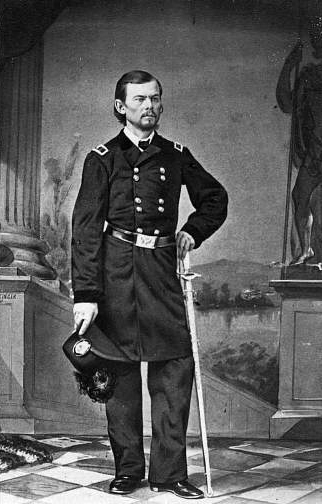
Though often described as an inept leader, Abraham Lincoln promoted Franz Sigel to the rank of Major General, knowing it would entice German immigrants to enlist in the Union army.
I have written many articles on the history of Missouri, specifically, articles about the effect that “Mr. Lincoln’s War” had upon the state.
Missouri was originally settled by the French, then the Scots-Irish, who had also settled the majority of Southern states.
The Scots-Irish who settled the South ( and Missouri) had a much different culture than the English who had settled the North or the Germans who would later immigrate to America.
Fred DeArmond,in an article titled “Scotch-Irish Heritage”, (published in the Summer, 1971 issue of the White River Quarterly), wrote:
“The chief ethnic strain among native Ozarks people is called Scotch-Irish.”1
Katrina Garstka wrote in a 2009 article titled “The Scots-Irish in the Southern United States: An Overview”, described the Scots-Irish as follows:
“Once in America, they formed a more-or-less cohesive unit, if that can be said of a people who nurtured a proud and sometimes argumentative spirit, and a disdain for authority.”2
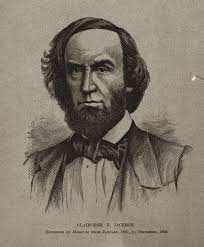
Missouri Governor Claiborne Fox Jackson called Abraham Lincoln’s call for Missouri to furnish four regiments of militia to put down the rebellion ,”illegal, unconstitutional, and revolutionary “
After the firing on Fort Sumter, South Carolina on April 12-13, 1861, President Lincoln called for the states to supply their share of 75,000 troops to put down the rebellion and it is this disdain for authority which led Missouri Governor Claiborne Fox Jackson to issue the following response to Lincoln:
“Sir: Your dispatch of the 15th instant, making a call on Missouri for four regiments of men for immediate service, has been received. There can be, I apprehend, no doubt that the men are intended to form a part of the President’s army to make war upon the people of the seceded states. Your requisition, in my judgment, is illegal, unconstitutional, and revolutionary in its object, inhuman, and diabolical and cannot be complied with. Not one man will the State of Missouri furnish to carry on any unholy crusade.”3
This set the stage for a showdown between Missouri’s Unionists and Secessionists, which can be more accurately described as a showdown between Missouri’s Scots-Irish and the German immigrants who had settled in the state over the past decade.
These German immigrants had concentrated in the area in and around St. Louis and were looked upon with suspicion, long before the outbreak of the war. Dr. Diane Mutti-Burke described the image that Americans (especially Missourians) held of German immigrants during the mid-nineteenth century:
“Louis Gerteis, a Civil War historian, recalls a common image that Americans had of Germans in the mid-19th century: that of a lager-drinking, Sabbath-breaking, and tenaciously proud group of people.”
Unlike the Scots-Irish who held great disdain for authority, the Germans of Missouri embraced it and admired Lincoln’s vision of a strong central government. This did not go unnoticed by leaders of Missouri’s Unionists factions who used them to capture an encampment of the Missouri State Guard at St. Louis named “Camp Jackson” after the Governor of the state.
“[General] Lyon responded to the perceived threat to control of the Arsenal with force. On May 10, 1861, Lyon surrounded Camp Jackson with pro-Union volunteer “Home Guards” (mostly drawn from the German immigrants of St. Louis), and took the Militia prisoner. As the prisoners were marched to the Arsenal, a riot broke out on the streets. During two days of rioting and gunfire, several soldiers, prisoners, and civilian bystanders were killed.Alarmed by the incident, the Missouri Legislature immediately acted on Governor Jackson’s call for a bill dividing the state into military districts and authorizing a State Guard.”4
After the “Camp Jackson Affair” (also referred to as the St. Louis Massacre by Southerners), Missouri’s German population was no longer looked at as simply crude, prideful guzzlers of lager, they were looked at as the ultimate enemy, the killer of innocent parties by the native Missourians, who were now flocking in to the Southern ranks and aligning themselves with the Confederacy.
Lincoln saw the value of using the Germans to put down the rebellion and promoted Germans to leadership positions in the Union army. One such appointment Lincoln made was to Franz Siegle who was made a colonel after the capture of Camp Jackson. Sigel was later promoted to the rank of Major General.
The move worked and Germans joined to fight for him. During the war, Sigel:
“…developed a reputation as an inept general, but his ability to recruit and motivate German immigrants kept him employed in a politically sensitive position. Many of these soldiers could speak little English beyond “I’m going to fight mit Sigel”5
By the time the war ended , Missouri was controlled by the Radical Republicans who implemented harsh Reconstruction policies through the adoption of the Drake Constitution. The Germans would soon learn that authoritarianism wasn’t all it was cracked up to be.
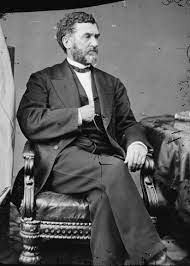
Charles Drake, was the namesake for Missouri’s constitution of 1865. Through his leadership and proposals the “Drake Constitution” ensured the Radical Republican rule of the state through its disenfranchisement of Missouri’s former Confederates as well as the State’s loyal German immigrants.
The Drake Constitution’s namesake was Charles Drake, a Cincinnati, Ohio born lawyer who had moved to St. Louis in 1834.
Drake was a staunch opponent of slavery and a staunch proponent of the disenfranchisement and harsh treatment of Southerners. He was a member of the Missouri House of Representatives from 1859-1860 , became a delegate and Vice President of the Missouri Constitutional Convention of 1865 and was influential in implementing his authoritarian vision for the state:
“The new Constitution was adopted [in 1865 ] and became known as the “Drake constitution.” The Radicals maintained absolute control of the state from 1865 to 1871, with Drake as their leader.
To maintain power, Drake and the Radical Republicans disfranchised every man who had supported the Confederacy, even indirectly.
They made an 81-point checklist of actions. The United States Supreme Court reversed the imposition of the oath on ministers, and became a highly controversial political issue across the state.
The German Republicans in particular were angry.To further bolster his voting base, he secured the franchise for all black men in Missouri, despite qualms held by many Republicans. “6
Kristen L. Anderson, in an article published in the Fall, 2008 issue of the Journal of American Ethnic History noted that one particular point of contention of the Germans concerning the Drake Constitution were the religious provisions of the document. Anderson writes:
“More upsetting to most was the provision requiring priests and ministers to take the same loyalty oath as voters in order to preach or perform marriages.”
Anderson notes that Conservative Germans:
“Mocked radical Germans for finally realizing that the politicians they helped elect did not share their views on religion.”
Anderson quoted one newspaper correspondent who stated his opinion of Charles Drake noting that:
“[Drake] has been all his life time a religious and political fanatic and has never concealed his hatred against the “German infidels”.
The correspondent also added that:
“Republican politicians, including B. Gratz Brown, were just as bad and were trying to establish the dominance of Puritan Christianity in Missouri.”7
Andrew L. Slap, in his book “The Doom of Reconstruction: Liberal Republicans in the Civil War Era”, writes:
“Despite cooperating with him to keep Missouri in the Union, the German had distrusted Drake since the 1850’s, when he belonged to the anti-immigrant Know – Nothing Party.
The German community saw new signs of Drake’s prejudices in several of the proposals for the new constitution, particularly restrictions on churches, exclusion of immigrant suffering, and realignment of voting districts in St. Louis. Not only would priests and ministers be forced to take a Loyalty Oath to preach but Drake wanted to give the State the right to tax churches. He singled out the Catholic Church , to which many Germans belonged, as a “money making” machine that was generally disloyal during the Civil War.”8
Though the Germans were loyal to the Federal authoritarian government in Missouri during the war, after the war they suffered the same fate of their former foes, Missouri’s Scots-Irish settlers and continued to suffer with them until 1871 when the state stopped forcing its citizens to take the “Loyalty Oath.”
In 1875 Missouri adopted a new , less stringent constitution, thus officially ending the Reconstruction era of the state allowing former Confederates , their sympathizers and their foes, the Germans, to once again hold political office, bringing an end to the Radical Republicans authoritarian regime in Missouri.
Bibliography:
“Scotch-Irish Heritage”, Fred DeArmond, Summer, 1971 issue of White River Heritage.
“The Scots-Irish in the Southern United States: An Overview”, Katrina Gatska, Archives (online) magazine, October 16, 2009.
Christensen, Lawrence O., Dictionary of Missouri Biography, University of Missouri Press, 1999, pp. 423–425
Christensen, Lawrence O., Dictionary of Missouri Biography, University of Missouri Press, 1999, pp. 423–425
“Enforcing a Vision of Community: The Role of the Test Oath in Missouri’s Reconstruction.” Civil War History 40.4 (1994): 292-307.
“German Americans, African Americans, and the Republican Party in St. Louis, 1865-1872”, Journal of American Ethnic History, Fall, 2008, pp. 34-51, Kristen L. Anderson
“The Doom of Reconstruction: The Liberal Republicans in the Civil War Era”, Andrew L.Slap, pp. 3-4.
Foothills Media LLC is proud to announce our latest t-shirt from our Heritage line of clothing. Our latest offering pays tribute to the rich history and hard work of those involved in our area’s logging industry. We hope you like it (we think it’s pretty cool)!
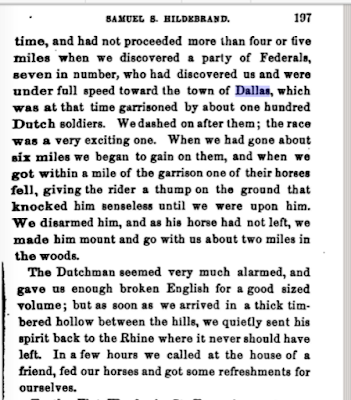
I was looking over some older articles I had previously published and stumbled upon this gem about Missouri bushwhacker Sam Hildebrand’s visit to Bollinger County, Missouri…
“Sam Hildebrand’s Confession” is certainly and interesting read. On pages 196-197 Hildebrand writes about a visit to Bollinger County, Missouri on May 25, 1864.
He writes of going in the direction of “Dallas” in Bollinger County [present day Marble Hill, Mo.] and encountering 7 federals [Union soldiers}.
Hildebrand notes that at the time Dallas was garrisoned by approximately 100 “Dutch” soldiers.
During this time it was common to refer to German immigrants as Dutch and Hildebrand relates the story of one that they captured who spoke in “broken English” who they executed stating, “We quietly sent his spirit back to the Rhine where it belonged”
They were seen as foreign invaders upon Missouri soil by native Southerners and it makes one wonder what feelings a citizen would have today if immigrant soldiers were garrisoned in a local community.
The purchase of our products helps fund our publications.
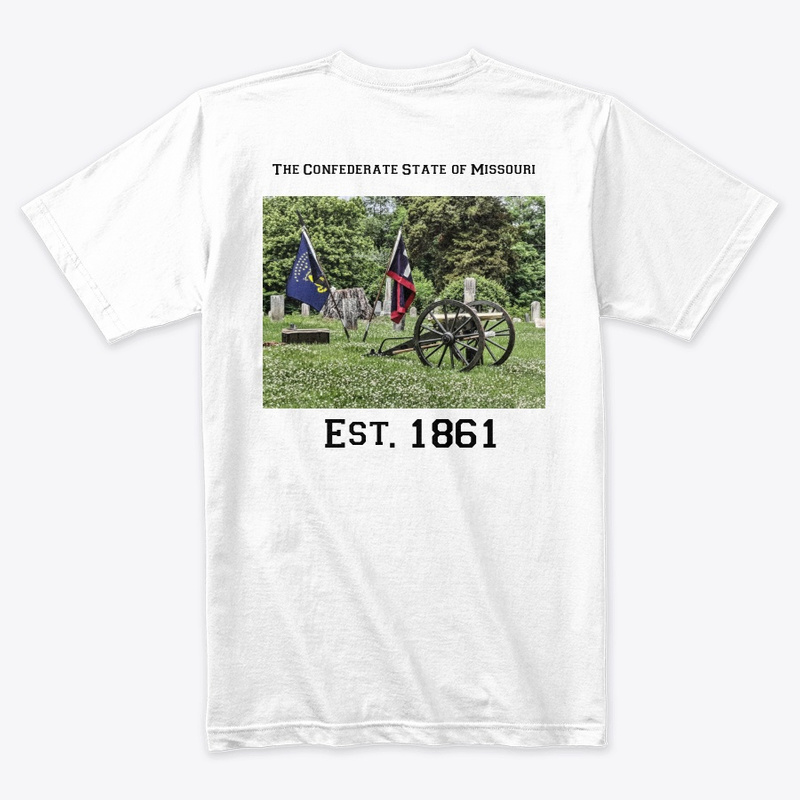
Our latest offering from our Foothills Media Heritage Clothing Line pays tribute to the South. T-shirt is white, 100% cotton and features our trademark Foothills Media logo on the front, with a cannon on the back. Back of shirt reads “The Confederate State of Missouri” and “Est. 1861”. This beautiful photo was taken during the Missouri Confederate Memorial Day service held in Bloomfield, Missouri on June 6, 2021. Your purchase supports independent media and helps preserve our history! $19.99 includes shipping and tax.
Announcing our Foothills Media Heritage Series line of apparel. Part of our mission is to find unique ways to preserve and promote local history and historic landmarks in the Southeast Missouri Ozarks. Our first offering features the Barks Plantation home located in Glen Allen, Missouri. Front of shirt features our trademark Foothills Media logo, with the plantation home featured prominently on the back of the shirt. Shirt is white and made of 100% cotton. $22.90 sizes range from Small to 5X.https://my-store-b97261.creator-spring.com/…/foothills…
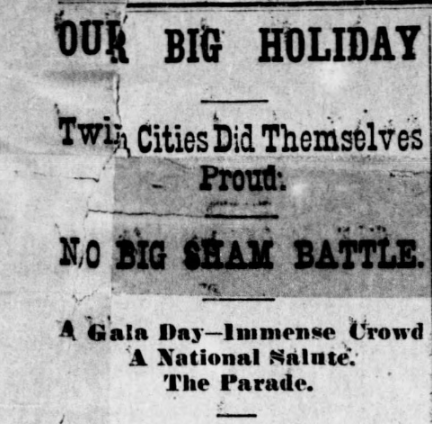
“The Twin Cities Did Themselves Proud”, this was the headline published in the July 6, 1893 edition of the Marble Hill Press, referring to a July 4, Independence Day celebration.
The celebration was a coordinated event between the cities of Marble Hill and Lutesville, Missouri (which were separated only by Crooked Creek).
By all accounts the event could only be described as a very “big deal”. According to the Marble Hill Press:
“Wrapt in admiration of the grand thoughts of that immortal document, the Declaration of Independence, and contemplation of the heroism that established its demands the people of Bollinger, Madison, Cape Girardeau, Wayne, Scott and Stoddard counties, to the number of perhaps, 7500 assembled at Conrad’s park, between the Twin Cities last Tuesday to celebrate the Nation’s Birthday.
At 4 o’clock in the morning the cannon from the two towns boomed out the glad tidings that just 117 years ago America was declared a free and independent government. The salute was a beautiful one in its significance. The Twin Cities jointly did honor to America’s Independence. Twenty- two guns were fired in Marble Hill and twenty-two in Lutesville, alternately, one for each of the grand states that form this union. At the conclusion of the salute every bell in the cities pealed forth the merry chimes of gladness.”
The Marble Hill Press also noted that at an early hour people started arriving in the Twin Cities , “In every kind of conveyance” and “the trains brought in hundreds, and they kept coming until noon.”
The Marble Hill Press listed the following organizations as taking part of the parade:
Sons of Veterans
The Grand Army of the Republic (Union veterans)
The Independent Order of Odd Fellows
Ancient Order of United Workmen
Sunday Schools
Information found in the September 30, 2017 issue of The Missouri Unionist (the newsletter for members of Missouri’s Sons of Union Veterans chapters), states that another event was planned by the Franklin Shanks Camp 100 (Lutesville), Grand Army of the Republic was planned and held 7 years prior and lasted from July 3-5, 1886.
In the article, meeting minutes from the Franklin Shanks Camp 100, Grand Army of the Republic were published:
“In the March 17, 1886, meeting minutes, the post discussed uniting with the Erich Pope (Pape) Post to decorate the graves of their fallen comrades and meet at the Lutesville Pavilion Grounds on July 3, 4 and 5.
This would involve all local GAR Posts. Hiram Gavitt Post 174 at Fredericktown was involved in at least one Decoration Day. In the April 14 minutes, the post commander reported sending invites to 13 other posts to attend. Invitations were also sent to Reverend B. St. James and J.J. Marks of St. Louis and B.L. Boman and J.J. Russel of Marble Hill.
The invitation committee was authorized to send invites to Ex- Governor Thomas Fletcher and Governor John Marmaduke. Ex Confederates J.V. Slinkard, W.B. Hawkins and L. Brinks were also invited.
While you had comrades planning the event you also had some who agreed to haul lumber and I assume build a stage for the dignitaries.
The July minutes report what a success the celebration was. It’s mentioned that representatives from several Missouri and Illinois posts attended.
Music was provided by the Marble Hill Cornet Band. On Saturday, the celebration was opened by a speech from “the Honorable H.N. Philips of Malden, MO. Known as the (Silver Tongued) orator of S.E. MO”
On Sunday after church sermons were given by Dr. J.J. Marks of St. Louis and Rev. B.L. Boman of Marble Hill, MO. They also mention delegations of “Federal and Confederate soldiers” but they don’t give any names.”
Support independent media by visiting our bookstore or by purchasing our merchandise.
Foothills Media Baseball Cap
White with our black Foothills Media trademark logo, our cap is 100% cotton, cool and comfortable, one size fits all with adjustable strap.
Join us Sunday June 6, 2021 for a Confederate Memorial Day Service which will be held at the Stoddard County Civil War Cemetery located in Bloomfield, Missouri. The service starts at 2:00 pm and will feature noted historian and public speaker Danny Honnell, a live fire cannon salute, and echo taps played on the hillside. Take Hwy 25 to Bloomfield, Missouri, turn on Hwy E, then to County Rd 517. Service will honor Confederate Veterans from Southeast Missouri.Sponsored by the Stoddard Rangers Camp #2290, Sons of Confederate Veterans.
The August 2, 1940 issue of the Dexter Statesman [Dexter, Missouri] published a photo of “Uncle” George Fox and Francis M. Snider , the last two surviving Civil War soldiers in Southeast, Missouri and noting that with the recent passing of Fox, Snider was the last surviving Civil War veteran in the Southeast Missouri district.
However, the paper did not reveal the two veterans loyalty during the war. I was able to find the information on a webpage that listed attendees of the 1938 Veterans Reunion held at Gettysburg, Pa. , remarkably both Fox and Snider both attended the event and were listed as serving in the Union Army.
Support independent media by visiting our bookstore.
In 1962 Hollywood came to Southeast Missouri to make a movie starring William Shatner According to Wikipedia.org:
“The Intruder is a 1962 American film directed and co-produced by Roger Corman and starring William Shatner. It is adapted from a 1959 novel by Charles Beaumont. The story depicts the machinations of a racist named Adam Cramer (portrayed by Shatner), who arrives in the fictitious small Southern town of Caxton in order to incite white townspeople to racial violence against black townspeople and court-ordered school integration.
The film is also known under its US reissue titles as I Hate Your Guts! and Shame, and The Stranger in the UK release.”
Since the movie was set in a small Southern town, Missouri’s “Bootheel” region was a natural location. The movie was actually shot in the towns of Charleston, East Prairie and Sikeston.
According to Wikipedia:
“Before it was finished, local people objected to the film’s portrayal of racism and segregation.”
The July 24, 1961 issue of Sikeston, Missouri’s The Daily Standard published a story which covered the start of film production, included a quote from William Shatner, who when asked, “What do you think of Sikeston?”, replied by stating, “It’s a lovely little town with nice people. If I wanted to live in a small town, Sikeston would be my choice.”
It’s a lovely little town with nice people. If I wanted to live in a small town, Sikeston would be my choice.
William Shatner, quoted in the July 24, 1961 The Daily Standard newspaper












 Foothills Media LLC