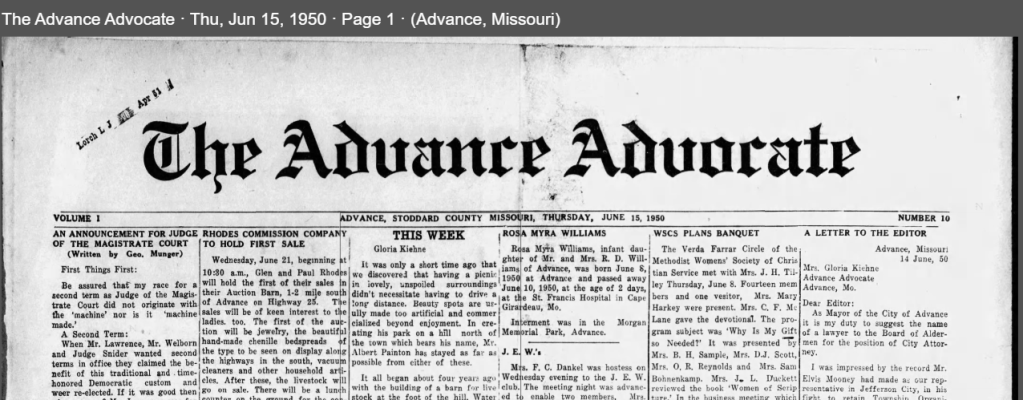
In my previous post I transcribed a lengthy feature article about Albert Painton’s “refuge” published on page 3 of the January 3, 1950, issue of the St. Louis Post-Dispatch. Combing through newspaper archives I found a local article published in the June 15, 1950, issue of the Advance Advocate [Advance, Missouri].
It was much the same as the Post-Dispatch article, whereas the Post-Dispatch article mentioned Mr. Painton informing a trapper that if a Fox that was in question, left the refuge it was fair game to the trapper but until then said fox was off limits. The Advance Advocate article cites that the same ultimatum was issued to a coon hunter. The article also mentioned that Mr. and Mrs. Painton bottle-fed two orphaned two baby raccoons and later released them when they were grown. One remained tame for at least one summer and would greet visitors to his park at the lake. The article goes into greater detail on how Mr. Painton created the lake and the park, and it is rather remarkable that a gentleman in his 70’s performed all of the painstaking labor himself to create it. I can confirm that the author of the article, Gloria Kiehne was correct about the view from the top of Mr. Painton’s hill. – Editor
It was only a short time ago that we discovered that having a picnic in lovely, unspoiled surroundings didn’t necessitate having to drive a long distance. Beauty spots are usually made too artificial and commercialized beyond enjoyment. In creating his park on a hill north of the town, which bears his name, Mr. Albert Painton has stayed away as possible from either of these.
It all began about four years ago with the building of a barn for livestock at the foot of the hill. Water stood over some of the land at that time until too late in the Spring for cultivation. Mr. Painton decided the best course of action was to drain the water into one large pond. The idea of fish in the pond soon followed. This was the groundwork for the park.
After that the need for a game refuge presented itself. Mr. Painton is a strong believer in clean fence rows, and while this added much to the appearance of a farm, it provides no cover for birds and small game. So the hill was to become their home. The timber on the hill was in a bad was because the water from the rainfall ran off too fast. The next step was to fence the entire area and terrace the hill. A stone wall was added to the hill side of the pond to hold the soil.
The landscaping was done by Mr. Painton, who planted the trees how he saw fit. He has a variety native of this part of the country and has an orchard of peach, cherry and plum between the terraces. There are no tame flowers there as he wished to avoid any man-made look, but wild iris, sweet williams, larkspur and columbine are abundant, and other wildflowers are getting a start. Last year several Hawthornes were planted, but although great care was exercised only a few survived.
Of course, no hunting or trapping is permitted, and this has given rise to at least one amusing incident. Mr. Painton has occasion to warn a couple of men about this restriction. They assured him that there was at least one big coon which came down from the hill and went over to a small streamed flat, and that they had traps set for him there. Mr. Painton replied: “That’s alright but as long as he is inside that fence, he is my coon and you let him alone.”
Mrs. Painton once raised on a bottle two small coons whose mother had somehow been killed. When they were old enough, they were set free on the hill. One of them remained quite tame and delighted picnickers throughout the summer by coming up to their tables and accepting food.
When the woods were cleared of limbs after the sleet storm last winter, Mr. Painton had them sawed into firewood and stacked for the convenience of those using the park. He charges no admission and gives permission freely, asking only that it not be abused. He has little trouble, since most people consider it a privilege to be able to enjoy such a grand place.
We were there early in the spring, and it was beautiful. The view from the hilltop is magnificent, but you had better take it slow getting to the top to really enjoy it. Where we went up it’s as nearly vertical as any mountain climber could wish. The smokestack from the cement plant in Cape Girardeau is visible, and other objects equally far away show up clearly.
Support Foothills Media by ordering your copy of “Blood in the Ozarks”
 Foothills Media LLC