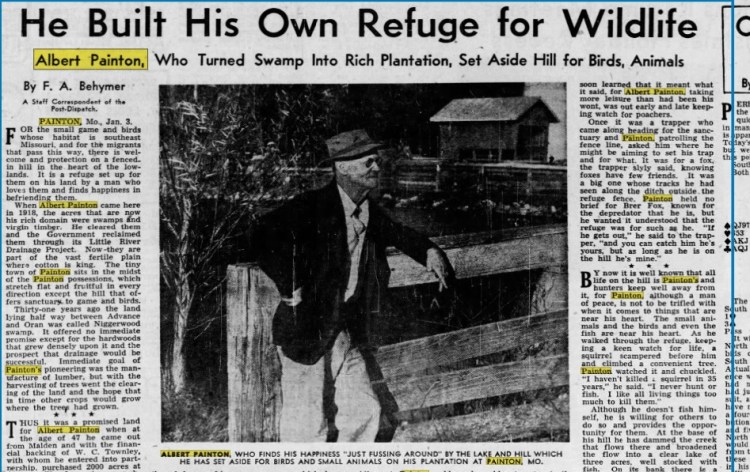
I’ve been doing a bit of newspaper archive “treasure hunting” lately and I stumbled upon an article of particular interest to me. The article appeared in the January 3, 1950 St. Louis Post-Dispatch newspaper on page 3 and titled “He Built His Own Refuge for Wildlife: Albert Painton Who Turned Swamp into Rich Plantation, Set Aside Hill for Birds and Animals”.
I grew up in the town of Painton. Well, by that time it was more of a “village” of about 50 people, but we still had a gas station and an airport (which featured air shows in my early days).
My father worked for the (then Cotton Belt Railroad), which later got absorbed by the Southern Pacific, which later got absorbed by the Union Pacific, which is currently trying to absorb the Norfolk Southern railroad (somebody make the merger craziness stop!).
The old store building mentioned in the article was still standing, as was the old schoolhouse. The lake and “refuge” mentioned in the article came to be known as “Painton Pond”. It was generally still open to all as long as permission was obtained. It was a favorite destination for my friends and I for camping and fishing when we were kids and was easily accessible via a quick bicycle ride.
One thing I’ve noticed while digging through old archives is that in the “old days” Southeast Missouri was often described as the South, and there were many mentions of plantations, (cotton was more prevalent in those days). I can’t help it if you don’t think so, I deal in facts.
Below is the article, which I have transcribed for your reading pleasure (for those who still read):
For the small game and birds whose habitat is southeast Missouri, and for the migrants who pass this way, there is welcome and protection on a fenced in hill in the heart of the low-lands. It is a refuge set up for him on his land by a man who loves them and finds happiness in befriending them.
When Albert Painton came here in 1918 , the acres that are now his rich domain were swamps and virgin timber. He cleared them and the government reclaimed them through its Little River Drainage Project. Now they are part of the vast fertile plain where cotton is king. The tiny town of Painton sits in the midst of the Painton possessions, which stretch flat and fruitful in every direction except the hill that offers sanctuary to game and birds.
Thirty-one years ago, the land lying halfway between Advance and Oran was called Niggerwood swamp. It offered no immediate promise except for the hardwoods that grew densely upon it and the prospect that drainage would be successful. Immediate goal of Painton’s pioneering was the manufacture of lumber, but with the harvesting of trees went the clearing of the land and the hope that in time other crops would grow where the trees had grown.
Thus it was a promised land for Albert Painton when at the age of 47 he came out from Malden and with the financial backing of W.C. Townley, with whom he entered into partnership, purchased 2000 acres at the prevailing low prices of public lands. Into the swamp he plunged, made there a home for his family and laid the foundation for the fortune that in the years to come he would win.
In the course of time the Painton enterprise became a family affair, for Painton the pioneer was fortunate in his children, two boys and four girls, all but one of whom have been and continue to be actively associated with him in the clearing and development of the land and his associated projects that were built up after he took over the interest of his partner.
The swamp when he came was alive with the game of the region that found dry footing on his 40-acre hill when the waters covered the land, and the birds were many in the treetops. In the small creatures and flocks he found companionship, and it was never his wish to destroy them. They were welcome to take forage from his forest and find refuge on his hill. They were not less welcome when the forest gave way to tilled filled and they fed upon his crops.
What was forest and swamp when the Painton’s came is a great plantation now, enlarged to 2,680 acres, crisscrossed with drainage ditches, where cotton, corn, soybeans and clover grow and herds of cattle and droves of hogs fatten. In the pastures are 80 Angus cows and in the fields there are 400 hogs all the time.
In the little town where the Painton’s live and which bears their name there is the Painton store that was set up to serve the needs of the timber cutters and has continued to supply the Painton tenants and their neighbors. In the store is the post office which Albert Painton served as the Postmaster for 20 years until he was retired at the age of 70. The post office is now in charge of his son-in-law L.E. Jefferies. One of his sons is the rural mail carrier for the area.
Painton and his children are content to cultivate about 1000 acres. The rest of the land is tilled by 10 tenants. Painton buys grain from other farmers and ships it out over the Cotton Belt, which has a siding at Painton station.
It is a matter of regret to Albert Painton that there is no school or church in the town of Painton, though the district school is not far away and churches are not too distant. When he came Painton felt an obligation to provide a church for his workers and others and built one near the store but there was not enough interest in it. In time it fell into disuse and was torn down.
All through the years when the Painton’s were redeeming the land and putting it to good uses , the 40-acre hill stood there in the midst of all their holdings, rock-ribbed, a geological upthrust of an ancient time, in a flat and rockless land serving no purpose except for sparse and casual pasturage.
Even that was poor use to make of it, as Painton came to realize, for the young trees were killed by the foraging animals and erosion set in. He decided that timber growth would be more profitable and would put a stop to the erosion.
Then, four years ago, it came to him that there was one good use to be made of it. It could be a refuge for small animals, as it had been when there was water over the land, and coverage for birds in need of it since the trees were leveled and even the fence rows of the latter time had been cleared by efficient farming.
No sooner though than done, Painton’s hill was named a game reserve, and a fence was put around it to make it stick against marauding stock and trespassing hunters. The invitation was to all wild things, squirrels, rabbits, raccoons, woodchucks, opossums and even foxes. For although foxes have their faults there was no way to exclude them without restricting the hill’s hospitality, and Painton didn’t want to do that. As for the birds, the refuge was theirs too, to be used accordingly to their need, particularly quail, whose lot it is to be hunted.
“No hunting” was the sign posted on the fence and hunters soon learned that it meant what it said, for Albert Painton, taking more leisure than had been his want, was out early and late keeping watch for poachers.
Once it was a trapper who came along heading for the sanctuary and Painton, patrolling the fenceline, asked him where he might be aiming to set his trap and for what. It was for a fox, the trapper slyly said, knowing that foxes have few friends. It was a big one whose tracks he’d seen along the ditch outside the refuge fence. Painton held no beef for Brer Fox, known for the depredator that he is, but he wanted it understood that the refuge was for such as he. “If he gets out,” he said to the trapper, “and you can catch him, he’s yours, but as long as he is on the hill, he’s mine.”
By now it is well known that all life on the hill is Painton’s and hunters keep well away for it, for Painton, although a man of peace, is not to be trifled with when it comes to things that are near his heart. The small animals and the birds and even the fish are near his heart. As he walked through the refuge, keeping a keen watch for life, a squirrel scampered before him and climbed a convenient tree. Painton watched it and chuckled. “I haven’t killed a squirrel in 35 years,” he said. “I never hunt or fish. I like all living things too much to kill them.”
Although he doesn’t fish himself, he is willing for others to do so and provides the opportunity to them. At the base of his hill, he has damned the creek that flows through there and broadened the flow into a clear lake of three acres, well stocked with fish. On its bank there is a park that is free to all who care to come. When they come they are likely to find him there, fussing around, as he says, with the things he likes to do.
Albert Painton is 78 now and he feels he has the right to fuss around, if he feels like it, with the things that he likes to do. Some men, when they have time for it, go to town and loaf around there, but that wouldn’t be any fun for Painton. Out there at his game refuge there is something to occupy his mind.
The hill and the lake that lies near it mean more to him than his many acres. His private park that is free to all is the apple of his eye. He leaves it to the boys to operate the farm and make the money and, shamelessly he admits, he spends it on his hill, his lake, and his park. And he says, “nobody in the world could get the thrill that I get.”
On the shore of his lake Albert Painton often stands where he was happiest, just fussing around with what he likes best to do. Behind him rises his hill, where the wild things are free and unafraid.
Support this website by purchasing “Blood in the Ozarks” by Clint Lacy
 Foothills Media LLC
One thought on “Albert Painton’s “Plantation””