Interview with Dr. Ed Devries on the Dixie Heritage Show 4/17/2020
Interview with Dr. Ed DeVries on TBR History Hour 4/17/2020

Book focuses on crime in Delaware County:
MARBLE HILL, Missouri – Foothills Media LLC is announcing the publication of “The Rape of Delaware County” by Clint Lacy.
The book is the result of several months of communication with Delaware County, Oklahoma, resident Edwin Turlington, who on April 14, 2014, shot a convicted felon who attacked him on his family’s property. The result is that Turlington launched his own investigation and fought the charges for over five years before they were finally dropped.
Through countless hours of interviews and research, a picture of protected informants, abusive jailers, and a lawyer who made international news when he was arrested in a murder-for-hire plot is presented. Delaware County used to be a safe-haven for outlaws, and, as Edwin Turlington found out, it still is. Lacy has also authored “Blood in the Ozarks.”
For more information, visit www.foothillsmedia.net.
Book Review, Guerillas in Missouri Jan 9/20
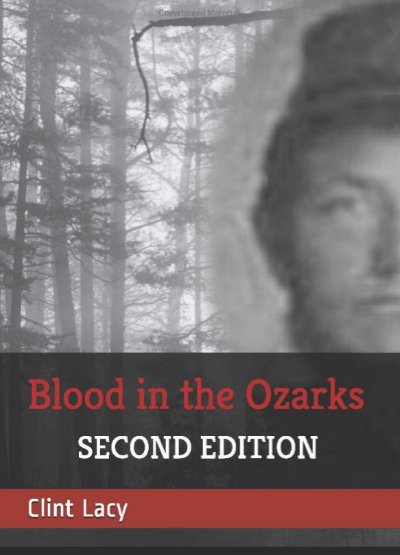
Special thanks to best-selling author Paulette Jiles for her very kind review of “Blood in the Ozarks: Second Edition” which was originally published on her website.
“On Amazon there are a great many books (non-fiction) on the guerillas in Missouri during the Civil War, and almost all of them have to do with the guerillas/bushwhackers in Central Missouri; Quantrell, Frank and Jesse James, Bloody Bill Anderson and others. Blood in the Ozarks by Clint Lacy is a much-needed look at the war in southeastern Missouri. In that area things were quite different and this work makes things about as clear as they are going to get.
The geography was different, the terrain and the people and the circumstances were different and other than Jerry Ponder’s books this is one of the few or perhaps only book dealing with the war in the southeast. I don’t have the reference here to hand but I believe it was the only part of Missouri held under martial law/reconstruction after the war was over. I think it was two years under martial law.
Other non-fiction studies; Gray Ghosts, Bushwhackers, Guerillas in Civil War Missouri and many others, almost all dealing with the better-documented activities of Confederate-sympathizing freelancers in Central Missouri.
The situation in the Ozarks of the southeast can be simplified more easily than in other places; it was mainly Tim Reeves Fifteenth Missouri State Guard units against Union units, mainly Missouri Militia (Union) and the Twelfth Cavalry (Union). The rivalry and intense, personal animosity between Reeves and the men of the Missouri Twelfth Cavalry (Wilson and Leeper) turn the situation into a terrible years-long vendetta and Lacy documents this extremely well, including civilian deaths. It occasioned one of the most moving, despairing and yet well-written night-before-the-execution letters I have ever read, that of Asa Ladd.
During a reading and book-signing a woman came up to me and told me she was a descendant of Asa Ladd, that it was in her great-grandmother’s house they had found the letter.
This book sets out this rivalry and the tragic consequences, and it all took place in the most difficult terrain, far from the notice of “important” people or newspapers, played out, one could say, almost in darkness.
My mother’s people were from Central Missouri and we have stories passed down about the bushwhackers — Bloody Bill Anderson came close to killing a distant relative of mine but said relative (George Brownfield) escaped into the thickets surrounding the Pilot Grove post office, dodging Bloody Bill’s bullets. There was a lot at stake in Central Missouri — good farmland, harvests of cotton and hemp, the great commercial highway that the Missouri River had become, not to speak of the extremely rich bottomlands of that great river.
My father’s people came from southeastern Missouri, the Ozarks, which was not in any way a vital area for crops, conscripts, herds or war products. We have no stories, only a confused report that my great-great-grandfather was hung, no details. Leaving a wife and three children and a pregnant wife; Mahala Giles. His name was Marquis Lafayette Giles, justice of the peace, taught the common school in Carter County.
Often in war, I have heard, from the participants, that certain units will develop an intense rivalry and hatred for one another — this happened to my husband in Vietnam. He was with an ARVN unit, as an advisor, spoke Vietnamese and lived with these troops. They got it on with a certain unit of the Viet Cong, and the two units fought each other for years. In the course of which my husband was wounded, got himself repaired and went back to the fight.
Also a wonderful man, a world war 2 vet, Charles Meuth, told me years ago that his unit of the Texas National Guard (141st Regiment) developed the same personal and intense rivalry with a certain unit of the German SS tank command and pursued them all the way up the Italian Peninsula and finally into Germany, where the war ended and they surrendered. He even knew their names.
So this is the drama and ferocity outlined in Lacy’s book, very well documented, a fascinating story of conflict played out in a country of great beauty but thin soil, heavy swamps, thick forest that almost nobody wanted, except the people who lived there. Blood In the Ozarks by Clint Lacy.”
Click Here to order “Blood in the Ozarks: Second Edition”
My Four- Part Series with Richard Syrett on His Conspiracy Unlimited Podcast:
GUEST: Clint Lacy is a life long resident of Missouri. He resides in the Eastern Ozarks foothills of Southeast Missouri. He is an independent writer who has been published in both mainstream and independent newspapers and magazines.
In 2015 he released his first book “Blood in the Ozarks: Union War Crimes Against Southern Sympathizers and Civilians in Occupied Missouri” his latest book is “The Beginner’s Guide to False Flags
My Appearance on the Rebel Yell Podcast
 Foothills Media LLC